

You are browsing environment: HUMAN GUT
CAZyme Information: MGYG000004151_02967
You are here: Home > Sequence: MGYG000004151_02967
Basic Information |
Genomic context |
Full Sequence |
Enzyme annotations |
CAZy signature domains |
CDD domains |
CAZyme hits |
PDB hits |
Swiss-Prot hits |
SignalP and Lipop annotations |
TMHMM annotations
Basic Information help
| Species | Pseudomonas citronellolis | |||||||||||
|---|---|---|---|---|---|---|---|---|---|---|---|---|
| Lineage | Bacteria; Proteobacteria; Gammaproteobacteria; Pseudomonadales; Pseudomonadaceae; Pseudomonas; Pseudomonas citronellolis | |||||||||||
| CAZyme ID | MGYG000004151_02967 | |||||||||||
| CAZy Family | GT2 | |||||||||||
| CAZyme Description | D-alanine--poly(phosphoribitol) ligase subunit 1 | |||||||||||
| CAZyme Property |
|
|||||||||||
| Genome Property |
|
|||||||||||
| Gene Location | Start: 19320; End: 37931 Strand: + | |||||||||||
CDD Domains download full data without filtering help
| Cdd ID | Domain | E-Value | qStart | qEnd | sStart | sEnd | Domain Description |
|---|---|---|---|---|---|---|---|
| cd17655 | A_NRPS_Bac | 0.0 | 515 | 1002 | 1 | 490 | bacitracin synthetase and related proteins. This family of the adenylation (A) domain of nonribosomal peptide synthases (NRPS) includes bacitracin synthetases 1, 2, and 3 (BA1, also known as ATP-dependent cysteine adenylase or cysteine activase, BA2, also known as ATP-dependent lysine adenylase or lysine activase, and BA3, also known as ATP-dependent isoleucine adenylase or isoleucine activase) in Bacilli. Bacitracin is a mixture of related cyclic peptides used as a polypeptide antibiotic. This family also includes gramicidin synthetase 1 involved in synthesis of the cyclic peptide antibiotic gramicidin S via activation of phenylalanine. NRPSs are large multifunctional enzymes which synthesize many therapeutically useful peptides in bacteria and fungi via a template-directed, nucleic acid independent nonribosomal mechanism. These natural products include antibiotics, immunosuppressants, plant and animal toxins, and enzyme inhibitors. NRPS has a distinct modular structure in which each module is responsible for the recognition, activation, and in some cases, modification of a single amino acid residue of the final peptide product. The modules can be subdivided into domains that catalyze specific biochemical reactions. |
| cd17646 | A_NRPS_AB3403-like | 0.0 | 5597 | 6094 | 1 | 488 | Peptide Synthetase. The adenylation (A) domain of NRPS recognizes a specific amino acid or hydroxy acid and activates it as an (amino) acyl adenylate by hydrolysis of ATP. The activated acyl moiety then forms a thioester bond to the enzyme-bound cofactor phosphopantetheine of a peptidyl carrier protein domain. NRPSs are large multifunctional enzymes which synthesize many therapeutically useful peptides in bacteria and fungi via a template-directed, nucleic acid independent nonribosomal mechanism. These natural products include antibiotics, immunosuppressants, plant and animal toxins, and enzyme inhibitors. NRPS has a distinct modular structure in which each module is responsible for the recognition, activation, and in some cases, modification of a single amino acid residue of the final peptide product. The modules can be subdivided into domains that catalyze specific biochemical reactions. |
| cd17646 | A_NRPS_AB3403-like | 0.0 | 514 | 998 | 1 | 488 | Peptide Synthetase. The adenylation (A) domain of NRPS recognizes a specific amino acid or hydroxy acid and activates it as an (amino) acyl adenylate by hydrolysis of ATP. The activated acyl moiety then forms a thioester bond to the enzyme-bound cofactor phosphopantetheine of a peptidyl carrier protein domain. NRPSs are large multifunctional enzymes which synthesize many therapeutically useful peptides in bacteria and fungi via a template-directed, nucleic acid independent nonribosomal mechanism. These natural products include antibiotics, immunosuppressants, plant and animal toxins, and enzyme inhibitors. NRPS has a distinct modular structure in which each module is responsible for the recognition, activation, and in some cases, modification of a single amino acid residue of the final peptide product. The modules can be subdivided into domains that catalyze specific biochemical reactions. |
| cd17646 | A_NRPS_AB3403-like | 0.0 | 3041 | 3525 | 1 | 488 | Peptide Synthetase. The adenylation (A) domain of NRPS recognizes a specific amino acid or hydroxy acid and activates it as an (amino) acyl adenylate by hydrolysis of ATP. The activated acyl moiety then forms a thioester bond to the enzyme-bound cofactor phosphopantetheine of a peptidyl carrier protein domain. NRPSs are large multifunctional enzymes which synthesize many therapeutically useful peptides in bacteria and fungi via a template-directed, nucleic acid independent nonribosomal mechanism. These natural products include antibiotics, immunosuppressants, plant and animal toxins, and enzyme inhibitors. NRPS has a distinct modular structure in which each module is responsible for the recognition, activation, and in some cases, modification of a single amino acid residue of the final peptide product. The modules can be subdivided into domains that catalyze specific biochemical reactions. |
| cd17655 | A_NRPS_Bac | 0.0 | 3042 | 3528 | 1 | 489 | bacitracin synthetase and related proteins. This family of the adenylation (A) domain of nonribosomal peptide synthases (NRPS) includes bacitracin synthetases 1, 2, and 3 (BA1, also known as ATP-dependent cysteine adenylase or cysteine activase, BA2, also known as ATP-dependent lysine adenylase or lysine activase, and BA3, also known as ATP-dependent isoleucine adenylase or isoleucine activase) in Bacilli. Bacitracin is a mixture of related cyclic peptides used as a polypeptide antibiotic. This family also includes gramicidin synthetase 1 involved in synthesis of the cyclic peptide antibiotic gramicidin S via activation of phenylalanine. NRPSs are large multifunctional enzymes which synthesize many therapeutically useful peptides in bacteria and fungi via a template-directed, nucleic acid independent nonribosomal mechanism. These natural products include antibiotics, immunosuppressants, plant and animal toxins, and enzyme inhibitors. NRPS has a distinct modular structure in which each module is responsible for the recognition, activation, and in some cases, modification of a single amino acid residue of the final peptide product. The modules can be subdivided into domains that catalyze specific biochemical reactions. |
CAZyme Hits help
| Hit ID | E-Value | Query Start | Query End | Hit Start | Hit End |
|---|---|---|---|---|---|
| QND46664.1 | 0.0 | 589 | 3582 | 1 | 2635 |
| BAY90071.1 | 0.0 | 228 | 3609 | 303 | 3284 |
| BAZ00088.1 | 0.0 | 237 | 3609 | 313 | 3293 |
| BAZ75991.1 | 0.0 | 237 | 3609 | 313 | 3293 |
| BAY30132.1 | 0.0 | 237 | 3609 | 313 | 3295 |
PDB Hits download full data without filtering help
| Hit ID | E-Value | Query Start | Query End | Hit Start | Hit End | Description |
|---|---|---|---|---|---|---|
| 6MFZ_A | 1.35e-293 | 4535 | 6182 | 208 | 1801 | Crystalstructure of dimodular LgrA in a condensation state [Brevibacillus parabrevis],6MFZ_B Crystal structure of dimodular LgrA in a condensation state [Brevibacillus parabrevis] |
| 6MFY_A | 4.19e-280 | 4535 | 6098 | 208 | 1716 | Crystalstructure of a 5-domain construct of LgrA in the substrate donation state [Brevibacillus parabrevis],6MG0_A Crystal structure of a 5-domain construct of LgrA in the thiolation state [Brevibacillus parabrevis],6MG0_B Crystal structure of a 5-domain construct of LgrA in the thiolation state [Brevibacillus parabrevis] |
| 6P1J_A | 9.81e-276 | 2585 | 3525 | 7 | 964 | Thestructure of condensation and adenylation domains of teixobactin-producing nonribosomal peptide synthetase Txo2 serine module [Eleftheria terrae],6P1J_B The structure of condensation and adenylation domains of teixobactin-producing nonribosomal peptide synthetase Txo2 serine module [Eleftheria terrae] |
| 6OYF_A | 9.19e-257 | 2585 | 3441 | 4 | 873 | Thestructure of condensation and adenylation domains of teixobactin-producing nonribosomal peptide synthetase Txo1 serine module [Eleftheria terrae],6OZV_A The structure of condensation and adenylation domains of teixobactin-producing nonribosomal peptide synthetase Txo1 serine module in complex with AMP [Eleftheria terrae],6P4U_A The structure of condensation and adenylation domains of teixobactin-producing nonribosomal peptide synthetase Txo1 serine module in complex with Mg and AMP [Eleftheria terrae] |
| 6P3I_A | 1.56e-243 | 53 | 914 | 6 | 873 | Thestructure of condensation and adenylation domains of teixobactin-producing nonribosomal peptide synthetase Txo1 serine module in complex with Mg [Eleftheria terrae] |
Swiss-Prot Hits download full data without filtering help
| Hit ID | E-Value | Query Start | Query End | Hit Start | Hit End | Description |
|---|---|---|---|---|---|---|
| P94459 | 0.0 | 53 | 4062 | 14 | 3582 | Plipastatin synthase subunit D OS=Bacillus subtilis (strain 168) OX=224308 GN=ppsD PE=1 SV=2 |
| Q4WVN4 | 0.0 | 87 | 6185 | 773 | 6558 | Nonribosomal peptide synthetase 8 OS=Neosartorya fumigata (strain ATCC MYA-4609 / Af293 / CBS 101355 / FGSC A1100) OX=330879 GN=NRPS8 PE=3 SV=1 |
| Q0VZ70 | 0.0 | 2576 | 5111 | 15 | 3057 | Chondramide synthase cmdD OS=Chondromyces crocatus OX=52 GN=cmdD PE=1 SV=1 |
| Q04747 | 0.0 | 56 | 4073 | 16 | 3571 | Surfactin synthase subunit 2 OS=Bacillus subtilis (strain 168) OX=224308 GN=srfAB PE=1 SV=3 |
| Q5AUZ6 | 0.0 | 13 | 6094 | 872 | 6652 | Nonribosomal peptide synthase atnA OS=Emericella nidulans (strain FGSC A4 / ATCC 38163 / CBS 112.46 / NRRL 194 / M139) OX=227321 GN=atnA PE=2 SV=1 |
SignalP and Lipop Annotations help
This protein is predicted as OTHER
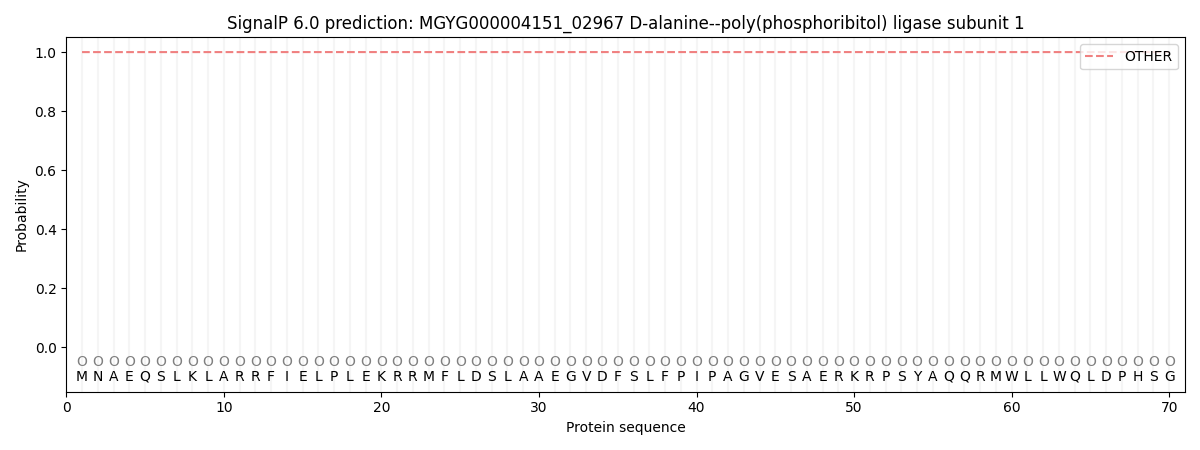
| Other | SP_Sec_SPI | LIPO_Sec_SPII | TAT_Tat_SPI | TATLIP_Sec_SPII | PILIN_Sec_SPIII |
|---|---|---|---|---|---|
| 1.000061 | 0.000000 | 0.000000 | 0.000000 | 0.000000 | 0.000000 |