
You are browsing environment: HUMAN GUT
CAZyme Information: MGYG000002151_00153
You are here: Home > Sequence: MGYG000002151_00153
Basic Information |
Genomic context |
Full Sequence |
Enzyme annotations |
CAZy signature domains |
CDD domains |
CAZyme hits |
PDB hits |
Swiss-Prot hits |
SignalP and Lipop annotations |
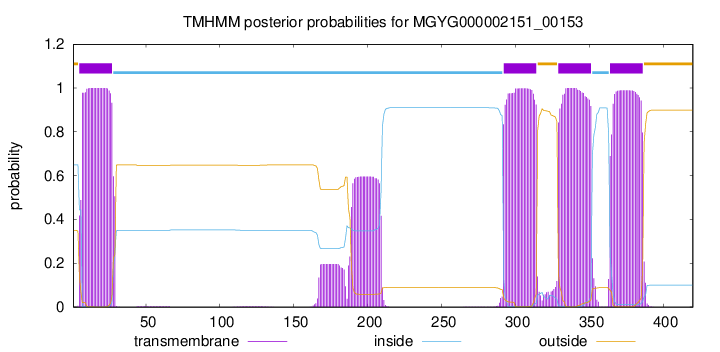
TMHMM annotations
Basic Information help
| Species | ||||||||||||
|---|---|---|---|---|---|---|---|---|---|---|---|---|
| Lineage | Bacteria; Firmicutes_A; Clostridia_A; Christensenellales; CAG-74; HGM11575; | |||||||||||
| CAZyme ID | MGYG000002151_00153 | |||||||||||
| CAZy Family | GT2 | |||||||||||
| CAZyme Description | Beta-monoglucosyldiacylglycerol synthase | |||||||||||
| CAZyme Property |
|
|||||||||||
| Genome Property |
|
|||||||||||
| Gene Location | Start: 9956; End: 11218 Strand: - | |||||||||||
CAZyme Signature Domains help
| Family | Start | End | Evalue | family coverage |
|---|---|---|---|---|
| GT2 | 41 | 265 | 1.9e-27 | 0.991304347826087 |
CDD Domains download full data without filtering help
| Cdd ID | Domain | E-Value | qStart | qEnd | sStart | sEnd | Domain Description |
|---|---|---|---|---|---|---|---|
| cd06438 | EpsO_like | 2.48e-64 | 47 | 225 | 2 | 183 | EpsO protein participates in the methanolan synthesis. The Methylobacillus sp EpsO protein is predicted to participate in the methanolan synthesis. Methanolan is an exopolysaccharide (EPS), composed of glucose, mannose and galactose. A 21 genes cluster was predicted to participate in the methanolan synthesis. Gene disruption analysis revealed that EpsO is one of the glycosyltransferase enzymes involved in the synthesis of repeating sugar units onto the lipid carrier. |
| COG1215 | BcsA | 1.68e-37 | 5 | 393 | 19 | 406 | Glycosyltransferase, catalytic subunit of cellulose synthase and poly-beta-1,6-N-acetylglucosamine synthase [Cell motility]. |
| cd06423 | CESA_like | 1.18e-30 | 47 | 222 | 2 | 180 | CESA_like is the cellulose synthase superfamily. The cellulose synthase (CESA) superfamily includes a wide variety of glycosyltransferase family 2 enzymes that share the common characteristic of catalyzing the elongation of polysaccharide chains. The members include cellulose synthase catalytic subunit, chitin synthase, glucan biosynthesis protein and other families of CESA-like proteins. Cellulose synthase catalyzes the polymerization reaction of cellulose, an aggregate of unbranched polymers of beta-1,4-linked glucose residues in plants, most algae, some bacteria and fungi, and even some animals. In bacteria, algae and lower eukaryotes, there is a second unrelated type of cellulose synthase (Type II), which produces acylated cellulose, a derivative of cellulose. Chitin synthase catalyzes the incorporation of GlcNAc from substrate UDP-GlcNAc into chitin, which is a linear homopolymer of beta-(1,4)-linked GlcNAc residues and Glucan Biosynthesis protein catalyzes the elongation of beta-1,2 polyglucose chains of Glucan. |
| pfam13641 | Glyco_tranf_2_3 | 1.14e-24 | 43 | 265 | 3 | 230 | Glycosyltransferase like family 2. Members of this family of prokaryotic proteins include putative glucosyltransferase, which are involved in bacterial capsule biosynthesis. |
| cd06437 | CESA_CaSu_A2 | 1.00e-18 | 52 | 266 | 11 | 232 | Cellulose synthase catalytic subunit A2 (CESA2) is a catalytic subunit or a catalytic subunit substitute of the cellulose synthase complex. Cellulose synthase (CESA) catalyzes the polymerization reaction of cellulose using UDP-glucose as the substrate. Cellulose is an aggregate of unbranched polymers of beta-1,4-linked glucose residues, which is an abundant polysaccharide produced by plants and in varying degrees by several other organisms including algae, bacteria, fungi, and even some animals. Genomes from higher plants harbor multiple CESA genes. There are ten in Arabidopsis. At least three different CESA proteins are required to form a functional complex. In Arabidopsis, CESA1, 3 and 6 and CESA4, 7 and 8, are required for cellulose biosynthesis during primary and secondary cell wall formation. CESA2 is very closely related to CESA6 and is viewed as a prime substitute for CESA6. They functionally compensate each other. The cesa2 and cesa6 double mutant plants were significantly smaller, while the single mutant plants were almost normal. |
CAZyme Hits help
| Hit ID | E-Value | Query Start | Query End | Hit Start | Hit End |
|---|---|---|---|---|---|
| ALU13522.1 | 1.14e-84 | 1 | 404 | 1 | 410 |
| QCT71577.1 | 1.14e-84 | 1 | 404 | 1 | 410 |
| ADO38773.1 | 6.37e-84 | 1 | 404 | 1 | 410 |
| ARD65366.1 | 6.37e-84 | 1 | 404 | 1 | 410 |
| AWW28570.1 | 2.25e-80 | 47 | 405 | 1 | 363 |
Swiss-Prot Hits download full data without filtering help
| Hit ID | E-Value | Query Start | Query End | Hit Start | Hit End | Description |
|---|---|---|---|---|---|---|
| Q8YMK0 | 4.10e-14 | 44 | 278 | 108 | 346 | Beta-monoglucosyldiacylglycerol synthase OS=Nostoc sp. (strain PCC 7120 / SAG 25.82 / UTEX 2576) OX=103690 GN=all4933 PE=1 SV=1 |
| Q3MB01 | 5.47e-14 | 44 | 278 | 108 | 346 | Beta-monoglucosyldiacylglycerol synthase OS=Trichormus variabilis (strain ATCC 29413 / PCC 7937) OX=240292 GN=Ava_2217 PE=1 SV=1 |
| P74165 | 4.23e-13 | 40 | 319 | 106 | 387 | Beta-monoglucosyldiacylglycerol synthase OS=Synechocystis sp. (strain PCC 6803 / Kazusa) OX=1111708 GN=sll1377 PE=1 SV=1 |
| P96587 | 1.98e-12 | 43 | 273 | 50 | 287 | Uncharacterized glycosyltransferase YdaM OS=Bacillus subtilis (strain 168) OX=224308 GN=ydaM PE=3 SV=1 |
| Q6G608 | 3.04e-06 | 47 | 272 | 52 | 277 | Poly-beta-1,6-N-acetyl-D-glucosamine synthase OS=Staphylococcus aureus (strain MSSA476) OX=282459 GN=icaA PE=3 SV=1 |
SignalP and Lipop Annotations help
This protein is predicted as OTHER

| Other | SP_Sec_SPI | LIPO_Sec_SPII | TAT_Tat_SPI | TATLIP_Sec_SPII | PILIN_Sec_SPIII |
|---|---|---|---|---|---|
| 1.000061 | 0.000000 | 0.000000 | 0.000000 | 0.000000 | 0.000000 |